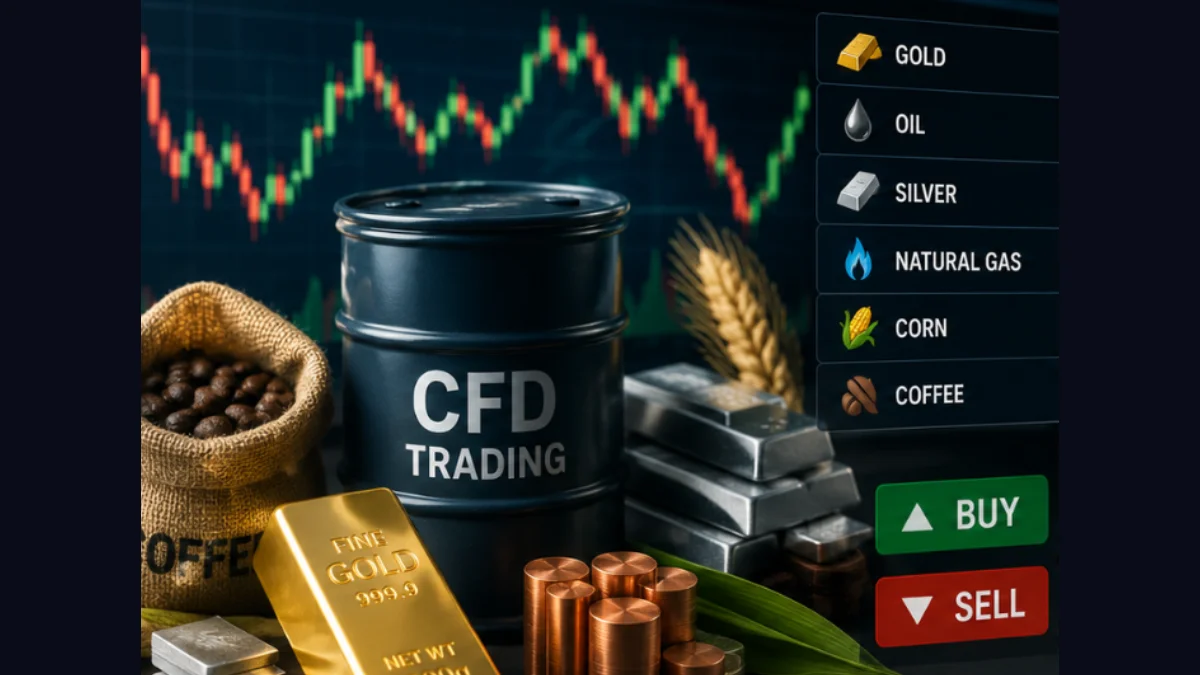
Most people who trade contracts for difference lose money. That is not a personal opinion. It is the warning published by Moneysmart, the Australian Government’s financial guidance website, which describes CFDs as high risk, complex and costly financial products. Yet Australian traders continue to open commodity CFD positions every day, drawn by capital efficiency and the chance to speculate on gold, energy, soft commodities and base metals without holding a single physical barrel, bar or bushel.
Understanding how CFDs behave, and what they mean for your tax return, is the difference between trading with your eyes open and trading blind. This article sets out the basics of commodity CFD trading, explains the risks that official guidance warns about, and shows why preparation matters before you fund an account.
What is a contract for difference?
A contract for difference is a financial product used to speculate on changes to the price of an underlying asset. That underlying asset can include shares, commodities, indices, forex, cryptocurrencies and bonds. In a CFD, the investor and broker exchange the difference in the asset’s value from the opening of the trade to the closing of the trade. If the price moves in your favour, the broker pays you the difference. If it moves against you, you pay the broker. At no point do you take delivery of the asset itself.
Commodity CFDs work in exactly the same way. Every transaction is settled in cash, which means clients gain exposure to commodities without physical delivery. Contracts expire monthly, so traders who want to keep a position open must be comfortable rolling exposure from one contract period to the next. This cash-settled structure is one of the main reasons commodity CFDs appeal to traders who want flexibility without the logistical challenges of owning physical raw materials.
Commodity CFD trading also provides a convenient and flexible approach to making predictions about price movements in various commodity markets, from agricultural products to precious metals. You can manage a diversified set of commodity exposures from one account, switch between markets quickly, and adjust positions as conditions change. That convenience is a genuine advantage, but it also encourages frequent activity, which means more trades to record, more costs to track and more decisions to defend.

Why commodity CFDs feel so attractive
The appeal of commodity CFD trading comes down to a few structural features. Capital efficiency is the big one. When you trade commodity CFDs, you only need to put up a margin payment, and that margin may be a small proportion of the total value of the raw material you are dealing on. That means a relatively small account balance can control a much larger market position.
The range of available markets adds to the attraction. Depending on your broker, you can choose from CFD markets covering shares, indices, forex, gold, commodities and cryptocurrencies, with competitive spreads on major instruments. Some platforms offer more than 2,250 tradeable products across forex, commodities, shares, cryptocurrencies, indices and bonds. Commodity CFDs specifically open the door to precious metals, energy, soft commodities and base metals, all from the same trading screen.
That flexibility is genuine. It is also the reason so many beginners underestimate the learning curve. A commodity CFD is not a simple bet on a price chart. It is a leveraged, cash-settled, monthly-expiring contract that demands constant attention to margin, costs and market conditions.
The tax implications of trading CFDs and commodities
The honest answer to the question of how CFDs and commodities are taxed in Australia is that it depends on your individual circumstances. The official guidance published by Moneysmart, and most educational material on CFD mechanics, focuses on how the products trade rather than on personalised tax outcomes. Nobody can give you a reliable tax answer without knowing how often you trade, whether trading is your main income source, and how your account is structured.
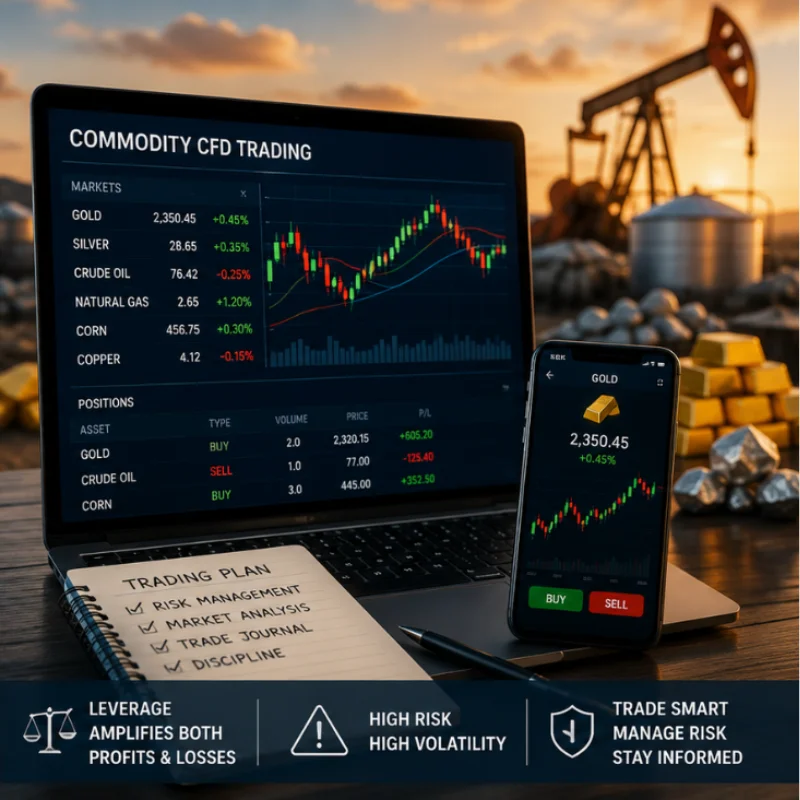
What you can do is prepare properly. Keep a clear record of every trade, every margin payment, every trade-related charge, and every deposit and withdrawal. Maintain a trading diary that explains the logic behind each position. Before you lodge a return that includes CFD or commodity gains or losses, confirm the current rules with the relevant tax authority or a registered tax agent who understands these products. Tax law changes over time, and a blog post cannot replace advice that is specific to your situation.
Before you open a commodity CFD position, ask yourself a few direct questions. Do you understand what it means when your margin payment is only a small proportion of the trade value? Do you know that every commodity CFD transaction is settled in cash and that contracts expire monthly? Have you tracked every charge attached to your trades? And who will review your tax position when the financial year ends? Answering those questions now is far cheaper than discovering the answers later.
The fact most traders prefer to ignore
Here is the number that should give every prospective trader pause: most people lose money trading CFDs. That is the message from Moneysmart, and it is consistent with warnings repeated across the financial services industry. CFDs are described in official guidance as high risk, complex and costly, and the arithmetic explains why.
Part of the problem is that CFDs are complex by design. They combine leverage, contract expiry and cash settlement in a single product, and each of those features carries its own risks. Moneysmart also points out that CFDs are costly, which means the odds are stacked against traders before a single position is opened. Understanding those costs, and building them into every trade plan, is the minimum standard for anyone who wants to trade CFDs and commodities seriously.
Leverage cuts both ways. A margin payment that is only a small proportion of the value of your position can produce outsized gains, but it can also produce outsized losses at exactly the same speed. The cash-settled, contract-roll structure of commodity CFDs adds another layer of complexity that novice traders rarely anticipate. Add in the costs of holding positions, and the result is an environment where going in unprepared is close to a guarantee of avoidable mistakes.
How education changes the picture
Nobody at N P Financials will tell you that education removes risk. What structured training can do is give you the knowledge and discipline that most losing traders lack. N P Financials is an Australian proprietary trading firm and trader education company, founded in 2013, that has trained more than 33,000 individuals globally. Its programs cover forex, shares, indices, commodities, intraday trading and cryptocurrencies, with a strong focus on practical skill rather than abstract theory.
The commodity trading course is designed for people who want to trade CFDs and commodities with confidence in their own analysis. Students receive personalised one-on-one coaching, master classes, real-time trade ideas and daily market insights. There is also serious attention paid to trader psychology, which is one of the most overlooked factors in consistent performance.
The typical N P Financials student is someone who wants more from the markets than a hobby. Many are aspiring traders, entrepreneurs, investment enthusiasts or people planning a career change. Others are chasing financial independence and the chance to work on their own terms. Whatever the starting point, the goal is the same: to learn a repeatable process rather than depend on luck.
If you are ready to treat trading as a skill to be built, the course details are available at https://npfinancials.com.au/commodity-trading/. You can also reach the team at +61 3 9790 9476 or info@npfinancials.com.au. The training centre is located at Level 3, 2 Brandon Park Drive, Wheelers
Frequently Asked Questions
1. Is CFD trading allowed in Australia?
Yes, CFDs are legally available in Australia. Moneysmart, the Australian Government’s financial guidance website, publishes detailed information about contracts for difference, which confirms they are regulated products that retail investors can trade. That said, being legal does not mean being safe. The same official guidance warns that CFDs are high risk, complex and costly, and that most people who trade them lose money.
2. Are CFDs suitable for beginners?
Most official guidance would say no, not without proper preparation. Moneysmart describes CFDs as high risk, complex and costly, which makes them a difficult starting point for anyone who does not yet understand margin, leverage and cash settlement. Beginners who decide to trade should first complete structured education, practise with clear risk rules and never risk money they cannot afford to lose. Most people lose money trading CFDs, so treat every trade as a lesson, not a lottery ticket.
3. Is trading CFDs basically gambling?
No, CFDs are financial products, not gambling, and in Australia they are regulated as such. A CFD is used to speculate on changes in the price of an underlying asset such as a share, commodity, index or currency. However, the experience can resemble gambling when trades are placed without a strategy. The difference is preparation. A disciplined trader relies on education, analysis and risk management, which is why training before trading makes such a difference.
4. What records should I keep when trading CFDs and commodities?
Keep everything. Save your trading statements, margin payment records, trade-related charges, bank deposits and withdrawals, and a written note of the reasoning behind each trade. These records help a registered tax agent assess whether your activity looks like investing or a business, and they make it far easier to confirm your obligations with the relevant tax authority. When tax time arrives, guesswork is the most expensive habit you can have.