
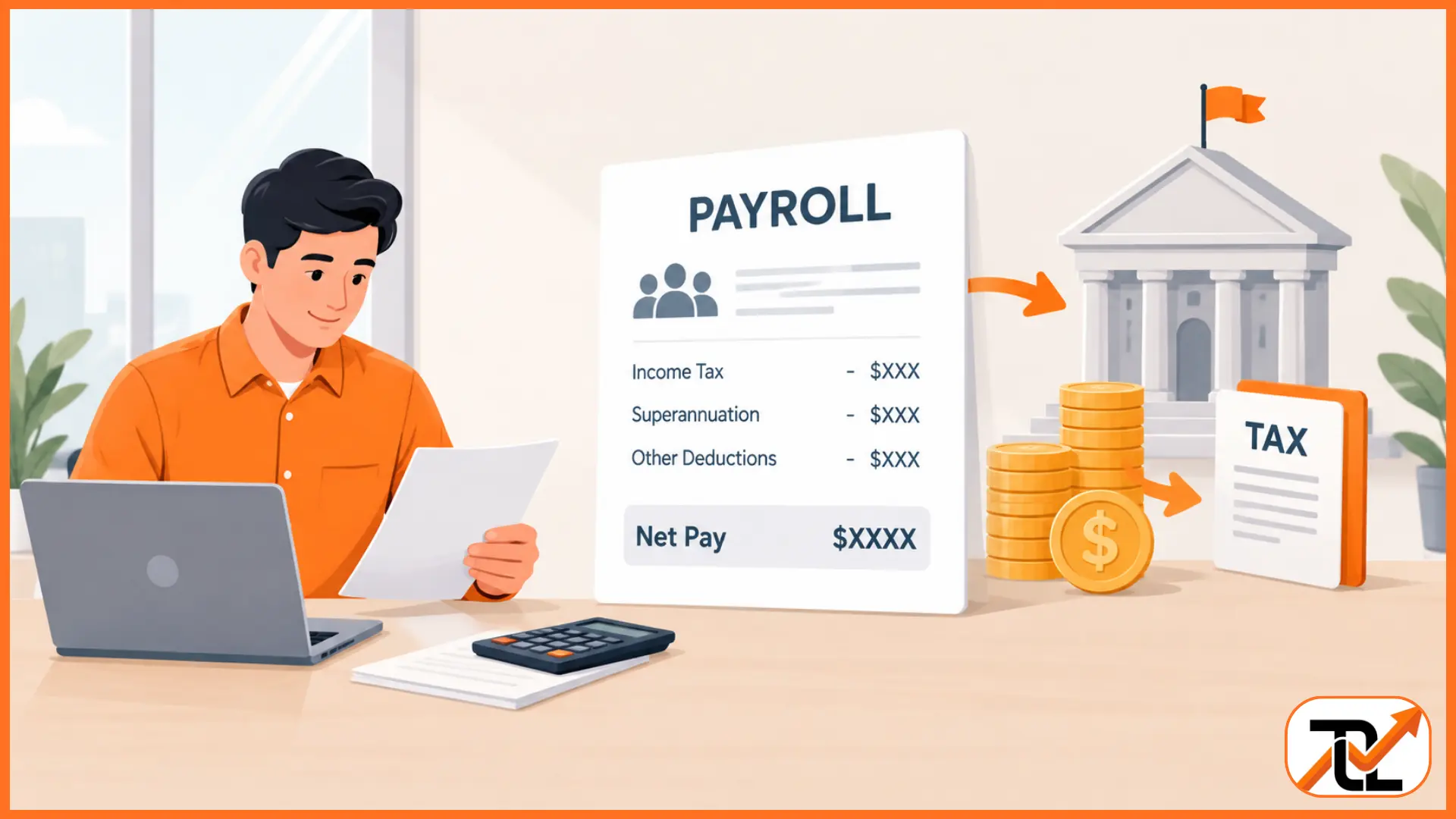
What is payroll tax? It is a state tax on wages that Australian employers pay once their total wages exceed a set threshold. Each state and territory runs its own system, with its own tax rates and thresholds. Employees never pay it. This article will explain what payroll tax is, how much it costs, who must register for it, which wages are taxable, and what your tax obligations are.
Quick Answer: What Is Payroll Tax and How Does it Work?
Payroll tax is a state or territory tax on wages paid by employers. It is not a tax on profit. It applies only when your total Australian wages exceed the threshold for your state or territory.
- Who pays: Employers pay it. It is not deducted from employee pay.
- What it applies to: Taxable wages, including salaries, bonuses, allowances, fringe benefits, superannuation contributions and certain contractor payments.
- When it applies: Once your total Australian wages exceed the tax-free threshold for your state or territory.
- Who collects it: The state revenue office in each jurisdiction.
- How it is reported: It is self-assessed. You calculate your own liability and lodge tax returns.
- How it differs from PAYG: PAYG withholding is a federal ATO obligation taken from employee pay. It is a separate state tax paid by employers.
How Is Payroll Tax Calculated?
In most jurisdictions, this tax is calculated on the taxable wages that exceed your threshold amount. The basic formula is:
(Taxable wages − threshold) × payroll tax rate = payroll tax payable
Example (NSW): An employer pays $2,000,000 in total Australian wages, all in New South Wales.
- Threshold: $1,200,000
- Wages above the threshold: $800,000
- Payroll tax rate: 5.45%
- Payroll tax payable: $800,000 × 5.45% = $43,600 for the financial year
Some states reduce or phase out the threshold for large payrolls. Businesses with employees in more than one state must also apportion wages between jurisdictions.
Who Needs to Register for it?
You must register for payroll tax with the state or territory revenue office if your wages exceed the threshold in that jurisdiction. This applies whether you are a sole trader, a company or a partnership. If you employ staff in more than one state, you may need to register in each one.
When Do You Need to Register for Payroll Tax?
You need to register once your total wages exceed the monthly threshold in any month. Your monthly threshold is the annual threshold divided by 12 (and adjusted for the number of days in the month in some states). Registration is generally due within seven days after the end of the month in which you exceed the threshold. Exact deadlines vary, so check your state revenue office.
Threshold checkpoints:
- Add up all wages you pay or that are payable in Australia, not just in one state.
- Include wages paid by any related businesses in your group.
- Register on time. Late registration can lead to penalties and interest.
Do Grouped Businesses Need to Register for Payroll Tax?
Yes. Businesses that are grouped for payroll tax share one threshold. One member of the group becomes the designated group employer (DGE) and lodges returns for the whole group. Other group members generally do not register separately, although they remain liable for it on a joint basis.
What Wages Are Taxable for Payroll Tax?
Payroll tax applies to wages paid or payable, which is a broad category. It is wider than the salaries shown on a payslip, and it also reaches some payments made outside normal employment.
What Are Taxable Wages?
Taxable wages generally include:
- Salary, wages, overtime and commissions
- Bonuses and allowances
- Superannuation contributions, including employer-paid super
- Fringe benefits (the grossed-up value is used in some states)
- Employment termination payments and leave payouts
- Directors’ fees
- Shares and options provided to employees
- Certain payments to contractors, including labour hire and agency workers
What Wages Are Exempt From Payroll Tax?
Exempt wages vary by jurisdiction. Common examples include:
- Wages paid by eligible charities, religious institutions and public benevolent institutions
- Wages paid by public hospitals and some schools
- Paid parental leave (exempt in many states)
- Wages for jury service or certain defence force leave
- Payments under a child endowment scheme
- Some apprentice and trainee wages (varies by state)
Because rules differ, check your state revenue office before you treat any wages as exempt.
What Are the Payroll Tax Rates and Thresholds in Each State and Territory?
Each state and territory sets its own rate and tax-free threshold. For 2026–27, most jurisdictions kept their 2025–26 settings. The Australian Capital Territory lowered its threshold and introduced a tiered scale. The Northern Territory added a higher rate for very large employers.
State and Territory Payroll Tax Rates:
| State/Territory | Annual Threshold | Monthly Threshold | General Payroll Tax Rate (2026–27) |
|---|---|---|---|
| New South Wales (NSW) | $1,200,000 | $100,000 | 5.45% |
| Victoria | $1,000,000 | $83,333 | 4.85% (plus surcharges for large employers) |
| Queensland | $1,300,000 | $108,333 | 4.75% (4.95% above $6.5m) |
| Western Australia | $1,000,000 | $83,333 | 5.5% |
| South Australia | $1,500,000 | $125,000 | 4.95% (2.5% on the first $200,000 above the threshold) |
| Tasmania | $1,250,000 | $104,167 | 4% ($1.25m–$2m), 6.1% above $2m |
| Australian Capital Territory | $1,750,000 (from 1 July 2026) | $145,833 | Tiered, starting at 6.75% |
| Northern Territory | $2,500,000 | $208,333 | 5.5% (6.5% for Australia-wide wages of $100m or more) |
Source: Payroll Tax Australia
How Do Payroll Tax Thresholds Work?
A threshold is the amount of wages you can pay each year before payroll tax applies. It is effectively a tax-free threshold, and it is also what separates small businesses from employers who must register.
- Annual vs monthly: The annual threshold is divided by 12 to give the monthly threshold.
- Total Australian wages: If you operate in several states, your total Australian wage bill is used to decide whether your threshold is reduced.
- Phase-outs: Some states reduce the threshold as your wages rise above set limits.
- Part-year employers: If you start paying wages partway through the financial year, your threshold is adjusted for the number of days.
What Is Payroll Tax Grouping?
Payroll tax grouping stops related businesses from each claiming a separate threshold. If businesses are grouped for payroll tax, their wages are combined and only one threshold applies.
Businesses can be grouped when:
- Common control: The same people or entities control the businesses.
- Related companies: The businesses are related bodies corporate.
- Common employees: Employees work for more than one entity in the group.
- Shared ownership or tracing: Interests in each business can be traced to the same owners.
Grouping rules are largely the same across all states and territories, because they have harmonised a number of key areas of tax legislation. Even so, each revenue office applies the rules in its own way, so check how your state does.
What Payroll Tax Exemptions Can Employers Claim?
An exemption removes certain wages from payroll tax. It is not the same as being tax-free for everyone. Employers can only claim an exemption if they meet the criteria set by their state or territory.
Common exemption categories include:
- Charitable and religious institutions, which may be exempt on wages paid to eligible workers
- Public hospitals and some non-government schools
- Wages paid for paid parental leave
- Some apprentice and trainee wages
- Wages for certain regional or disability employment programs (varies by state)
Note that an employer who qualifies for an exemption may still need to register, and in some cases must lodge returns showing exempt wages.
What Are Your Payroll Tax Obligations as an Employer?
Your tax obligations are to register on time, calculate your liability correctly, lodge returns and pay what is payable by the due date. Because payroll tax is self-assessed, the revenue office relies on you to get it right. They may audit you later.
Lodging Payroll Tax Returns:
- Lodge returns through your state or territory online portal.
- Most employers lodge monthly, though some smaller employers may lodge annually, if eligible.
- Report all wages paid in the period, including wages paid interstate and the value of fringe benefits where required.
- Complete the annual reconciliation after the end of the financial year to adjust your threshold and confirm the final amount you owe.
Payroll Tax Due Dates and Late Lodgment:
- Monthly returns: Generally due on the 7th of the following month in most states (the 21st in South Australia and the Northern Territory).
- Annual reconciliation: Generally due in late July after the end of the financial year (21 July in most jurisdictions).
- Late lodgment: Late lodgment or late payment can attract penalties and interest.
Always check your revenue office for the exact due dates, because they can change.
FAQs
Is Payroll Tax Paid by the Employer or the Employee?
Payroll tax is paid by employers on the wages they pay. It is not deducted from employee pay, and employees only pay income tax through PAYG withholding.
Do Small Businesses Need to Pay Payroll Tax?
Most small businesses do not, because their total wages stay below their state or territory threshold. Grouping, contractor payments and interstate wages can push you over the limit sooner than expected.
What Happens If an Employer Fails to Register for Payroll Tax?
The revenue office can assess the unpaid tax retrospectively and add interest and penalties. Register as soon as your wages exceed the threshold.
Conclusion
So, what is payroll tax? It is a state tax levied on wages paid by employers once total Australian wages exceed a threshold. Employers pay it, rates and thresholds differ in each state and territory, and the system is self-assessed.
To stay compliant, check your threshold, find out whether you are grouped with related businesses, register on time, and lodge your returns by the due dates. Always confirm the latest figures with your state revenue office or a registered tax professional.