
Outsourcing product design makes sense commercially, but it raises a practical question at tax time: what can you actually claim?
Most businesses that come to us with an idea ask this, and the answer is rarely a simple yes or no. Some invoices are deductible straight away. Some are spread over years. Some may qualify for the R&D Tax Incentive, which is worth far more than a standard deduction.
This guide walks through how outsourced design, prototyping, and tooling costs are usually treated. It also covers how to set up the engagement so your accountant has what they need.
Capital or revenue: the first question
How a design invoice is treated depends on what the work produces. In the industrial product design services for Melbourne, we see both kinds of work, often in the same project.
Revenue expenses are part of running the business day to day. Refining an existing product, fixing a design fault, or updating packaging usually falls here. These costs are generally deductible in the year you pay them.
Capital expenses build something lasting. Designing a brand new product, and the intellectual property behind it, is more likely to be capital. These costs usually can’t be deducted in one hit.
Capital doesn’t mean lost. Depending on the facts, capital design costs may be:
- Added to the cost of an asset you own, such as a patent, registered design, or tooling, and depreciated
- Deducted over five years as business-related capital expenditure under section 40-880
- Claimed under the R&D Tax Incentive, if the work involved eligible experimentation
The line between capital and revenue is not always clear. Have this conversation with your accountant before a large project starts.
Claiming outsourced design under the R&D Tax Incentive
The R&D Tax Incentive is often the biggest opportunity. Companies with aggregated turnover under $20 million can get a refundable offset of their company tax rate plus 18.5%. For a 25% base rate entity, that’s 43.5 cents back for every eligible dollar, even in a loss year.
You don’t need in-house engineers to claim. Fees paid to an external design firm can count, as long as the R&D is done for your company. In practice, that usually means you:
- Own the intellectual property the work creates
- Carry the financial risk if it doesn’t work
- Direct the project and make the key decisions
The work itself must still qualify. That means genuine experimentation where the outcome couldn’t be known in advance, such as testing a new mechanism, material or manufacturing method. Styling, market research and compliance testing don’t count.
The basics still apply. Only companies can claim; eligible spend must be at least $20,000 a year, and you must register within 10 months of your income year ending. Most R&D also needs to happen in Australia, so check before using an offshore design firm.
Prototypes and tooling
Prototypes built to test a design are usually used up in the process. Where they’re part of eligible R&D, they can be included in your R&D claim. Otherwise, they’re generally part of the wider design cost and follow the capital or revenue treatment above.
Production tooling is different. An injection mould is a depreciating asset that will produce parts for years. Its cost is claimed over its effective life, not as one expense.
Small businesses have two shortcuts. If your aggregated turnover is under $10 million and you use the simplified depreciation rules:
- Assets costing less than $20,000 can be written off in full under the instant asset write-off, which is now permanent from 1 July 2026
- Assets costing $20,000 or more go into the small business pool, deducted at 15% in the first year and 30% each year after
A simple tool or a vacuum casting master may fall under $20,000. A multi-cavity production mould usually won’t.
Who owns the mould matters. Tooling often stays at the manufacturer’s factory. If your contract says you own it, you’re generally the one who claims the depreciation. If the manufacturer owns it and recovers the cost through part prices, you claim the part costs instead. Make ownership clear in writing.
IP, patents and GST
Intellectual property. Patents, registered designs and copyright are treated as depreciating assets for tax. Their cost, including filing and attorney fees, is generally spread over a set effective life. A standard patent is 20 years and a registered design is 15 years. Make sure your design agreement assigns the IP to you, or you may not be able to claim it at all.
An Australian design firm registered for GST will add 10% to its invoices. If your business is registered for GST, you can usually claim that back as a GST credit on your BAS. Large tooling invoices can create a big credit in one quarter, which helps cash flow. Staged invoices spread both the cost and the credits across quarters.
Setting up the engagement
Good tax outcomes start with the contract and the paperwork, not at the end of the year. Before work begins with a design firm:
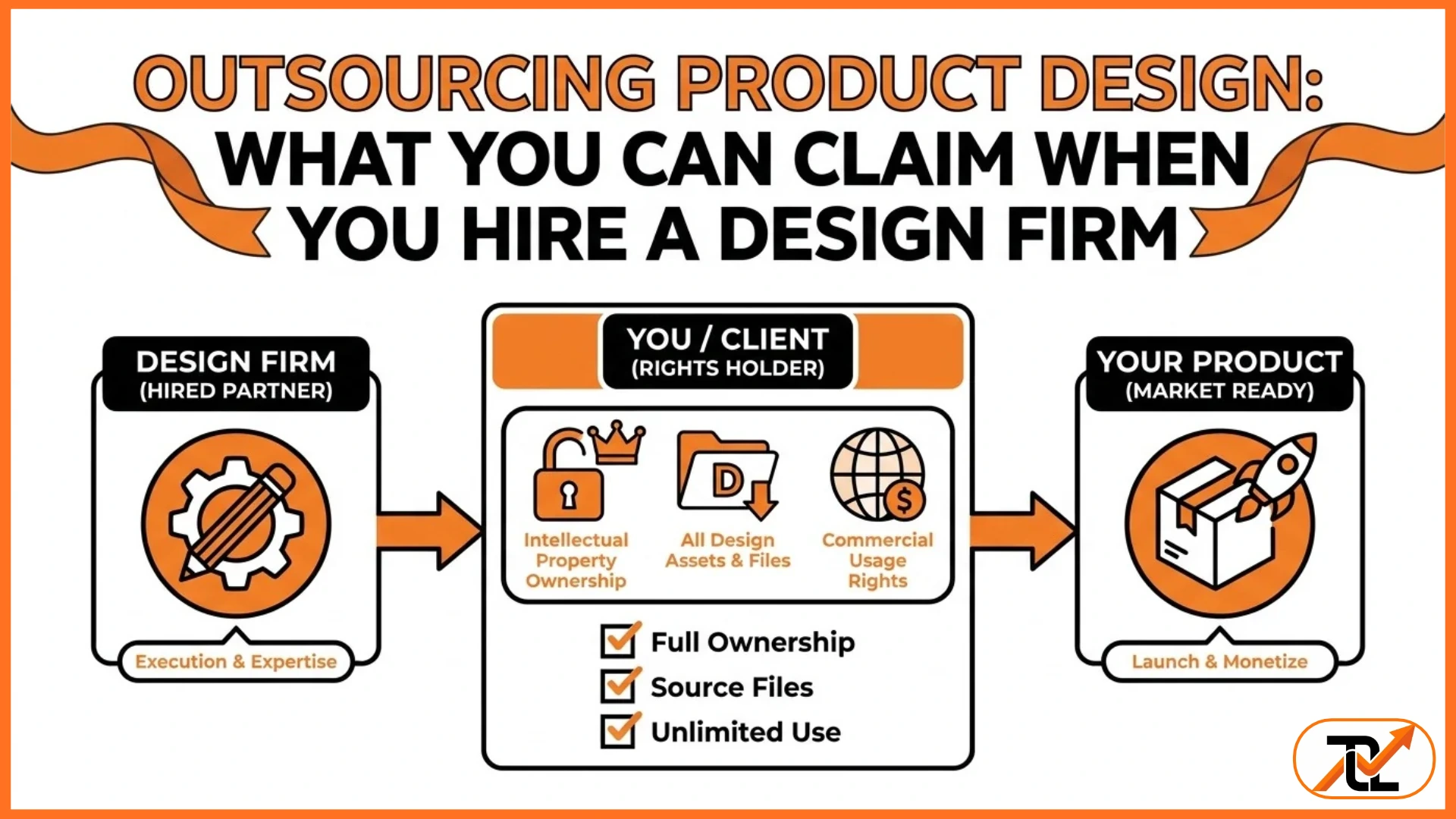
- Put IP ownership in writing. The agreement should assign all IP from the project to your company.
- Confirm tooling ownership. State who owns each mould and tool, even if it stays at the manufacturer.
- Ask for staged invoices. Separate invoices for concept, engineering, prototyping, tooling and IP make each cost easier to classify.
- Keep the technical records. Design briefs, CAD revisions, test reports and failed prototypes are the evidence behind an R&D claim.
- Talk to your accountant early. Registering for the R&D Tax Incentive and choosing how to treat capital costs is much easier before the money is spent.
A good design partner will be used to these requests. If they can’t break down their invoices or explain what testing was done, that’s worth knowing upfront.
Conclusion
Outsourcing product design doesn’t mean giving up tax benefits. Fees for experimental work can attract a refundable R&D offset. Tooling can be written off or pooled. IP can be depreciated, and GST credits help with cash flow along the way.
The value depends on decisions made before the project starts. Who owns the IP and tooling, how invoices are structured, and what records are kept all shape what you can claim. If you’re outsourcing product design, get your design partner and your accountant talking early. The tax side then becomes one less thing standing between your idea and a finished product.
The keyphrase now opens the first paragraph and starts the closing advice in the second. I split the last long sentence in two to make room for it.