
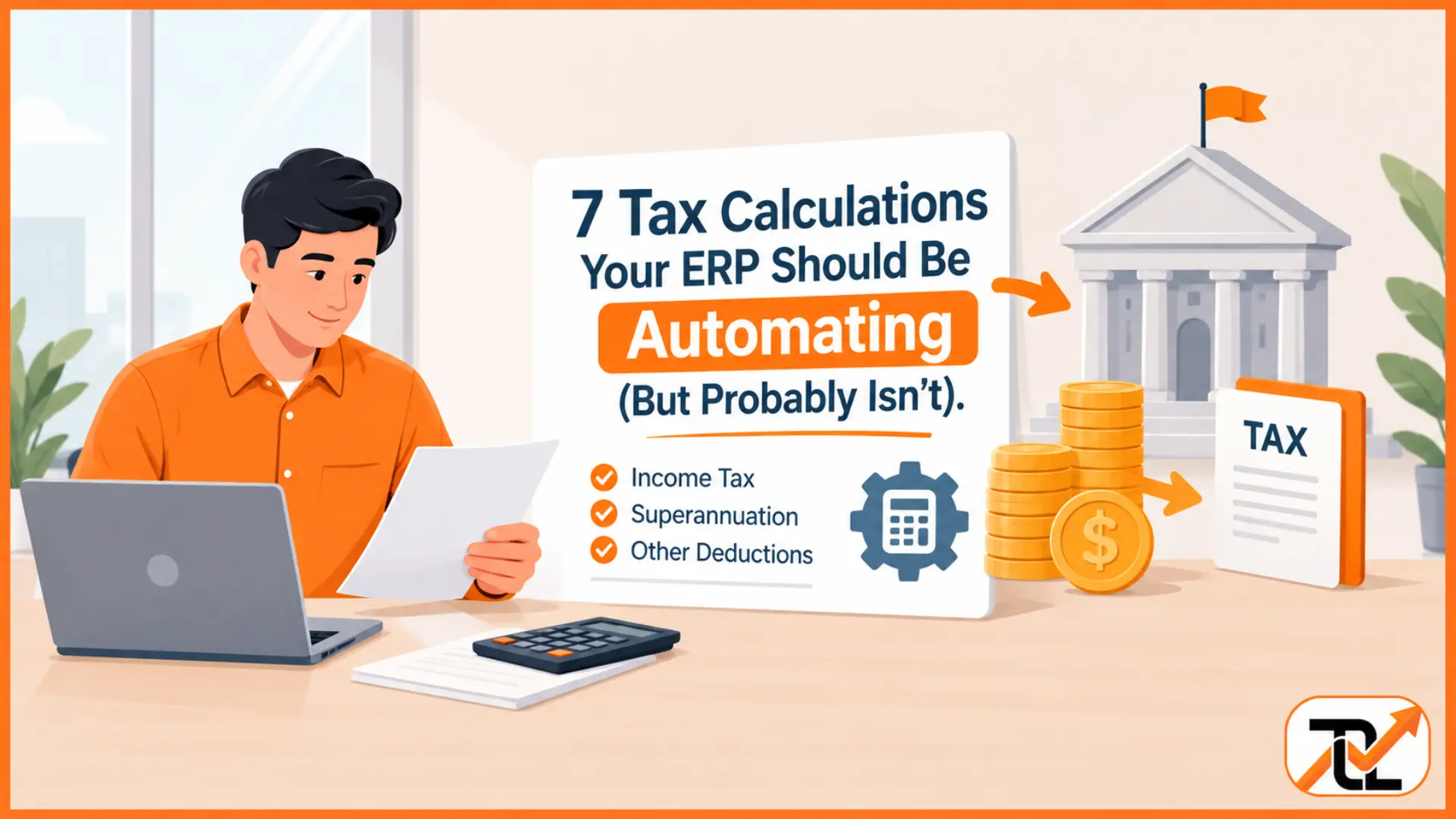
One client called their BAS process “the spreadsheet nobody wants to own.” Every quarter, someone pulls GST figures out of three different reports, cross-checks them by hand, and hopes nothing’s shifted since last time. Meanwhile the business runs a perfectly capable ERP. It just never got asked to do this particular job.
Nobody plans it that way. An ERP rollout has a go-live date and a budget, and tax automation is usually the thing that quietly falls off scope once both start running tight. The general ledger gets configured. Inventory gets configured. Tax gets left for “phase two,” and phase two rarely arrives.
What “ERP solutions for businesses” should actually mean
Search ERP solutions for businesses and most results point at procurement, stock control, consolidated reporting. Fine, as far as it goes. But a configured ERP is already sitting on the same data tax runs on: sales by state, payroll by employee, benefits provided, assets on the books.
If that’s already in one system, reconstructing it by hand each quarter isn’t really a technology gap. It’s a setup gap. Below are seven calculations that fall into that gap more often than you’d think.
1. GST and BAS reconciliation
Honestly, the invoicing side is usually fine, tax codes apply correctly there without much drama. What goes manual is reconciling input and output credits before lodgement, because nobody wired that step into the system when it was first set up. Fix that one piece and BAS stops being a fire drill every three months.
2. Payroll tax across multiple states
Different threshold per state. Different grouping rules if related entities are involved. A business with staff in NSW, Victoria and Queensland is running three separate calculations whether it realises it or not, and a spreadsheet will hold that together right up until a state budget moves a threshold or a new hire tips total wages past a line nobody was watching.
By the time that surfaces at the next lodgement, it isn’t a two-minute fix. It’s back-paid tax, interest, and an awkward conversation with whoever signed off on the figures.
3. PAYG withholding
The sum itself isn’t hard. Where businesses trip is the classification underneath it. Employees need PAYG withheld, reported, paid to the ATO. Genuine contractors generally don’t, unless they haven’t quoted an ABN or there’s a voluntary agreement in place.
Get that wrong and the penalty sits with the business, not the worker, which is reason enough to tie classification to the payroll module instead of leaving it as a judgement call made fresh each time someone’s hired.
4. Super guarantee, including payday super
This changed recently, and plenty of businesses are still running the old process. Super now has to be calculated and paid each payday, not pooled and settled quarterly. It’s as much a timing rule as a maths one. Build it into payroll once and it just happens with every run. Leave it manual and, well, it’s the kind of thing that’s fine for months until the month it isn’t.
5. Fringe benefits tax
A novated lease. A phone used for both work and personal calls. A staff Christmas party that crept slightly over the per-head limit. None of these announce themselves as a tax event at the time, which is exactly why FBT catches businesses out.
Whether something counts as a benefit at all is often a judgement call, and most of the information needed to make that call already sits in finance and HR records. Flag it as it’s recorded, rather than reconstructing twelve months of transactions in March, and FBT stops being an annual archaeology dig.
6. A running tax position, not a once-a-year guess
Most small and mid-sized businesses only find out what they actually owe once, right near lodgement. That’s a strange way to manage cash flow, when you think about it. Revenue, deductions and depreciation are already moving through the system continuously, so there’s no real reason the tax estimate can’t move with them. A business that knows its likely position in month four can plan around it: set money aside, time a purchase, adjust a dividend. Find out in month eleven and all you’re doing is reacting.
7. Asset depreciation
Spreadsheet asset registers drift, slowly and then not so slowly. An asset’s disposed of and the row doesn’t get updated. A new purchase rolls into the schedule a month late. Each error is small on its own, but they add up, and at some point what’s on the register no longer matches what’s being claimed. An asset module built into the ERP applies the right method and rate as assets move through their lifecycle, so the register and the return actually agree with each other.
Why none of this happens by itself
None of the above fixes itself just because a business bought an ERP. The tax rules need configuring for how the business actually operates. The data feeding those rules needs to be clean. And somebody needs to understand both the tax side and the system side well enough to connect the two properly, which is a narrower skill set than it sounds. Get the configuration wrong and the ERP will run an incorrect calculation with exactly the same confidence as a correct one.
This is where experienced MYOB consultants earn their fee: implementation is where a business’s actual payroll tax footprint, super obligations and FBT exposure get mapped into the system, rather than left running off whatever template came with the install.
The fix is usually configuration, not a rebuild
None of these seven calculations need a new finance system. Most need the one already sitting there, configured for the specific states a business operates in, the benefits it actually provides, the assets it actually holds.
Businesses still doing this by hand aren’t short on technology, as a rule. They’re short on someone having sat down and set the technology up to do what it was already built to do. That’s usually a smaller job than people expect, and worth running as its own piece of work rather than squeezing it into the margins of a bigger rollout. Treat it as an afterthought during implementation and, more often than not, it stays one indefinitely.